



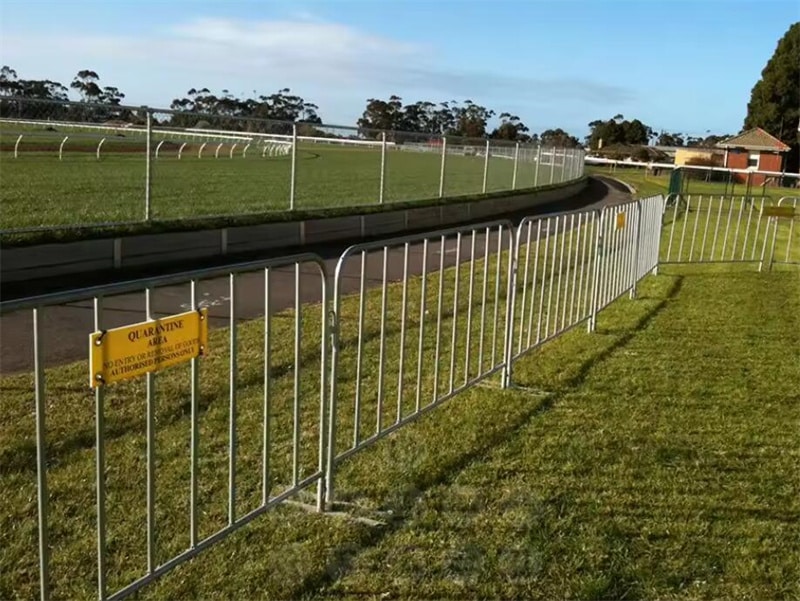
Every large-scale event has a moment where the difference between controlled and uncontrolled becomes visible — and it is almost always at the perimeter. The barrier system that defines crowd flow, separates spectators from operational areas, and communicates the boundaries of safe space to thousands of people simultaneously is not a peripheral logistical detail. It is the physical infrastructure that makes every other element of event management executable. For event planners, security coordinators, and municipal agencies whose professional reputation depends on events that run safely and efficiently, steel barricades represent the crowd control standard that temporary plastic alternatives and improvised solutions cannot match — combining structural integrity, rapid deployment capability, and the professional appearance that high-profile events demand in a system designed specifically for the demands of professional crowd management.
Understanding what steel barricades deliver, where they perform best, and how to deploy them effectively is foundational knowledge for any organization managing crowds at scale.
Why Steel Is the Professional Crowd Control Standard
The dominance of steel barricades in professional event management is not a matter of convention or inertia. It reflects specific material and structural advantages that alternative crowd control solutions — plastic barriers, rope and stanchion systems, temporary fencing — do not replicate at the crowd pressures and operational scales that serious events generate.
Structural integrity under crowd pressure. The physics of crowd behavior at large events produce lateral forces on barrier systems that most people significantly underestimate. A crowd of several thousand people moving in a common direction — toward a stage, away from an incident, or simply compressed by density — generates sustained lateral pressure that lightweight barrier systems fail under before the crowd pressure reaches its peak. Steel barricades are engineered to resist these forces — their structural gauge, connection hardware, and base geometry designed for the specific loading conditions of crowd contact rather than the incidental pressure that lighter barriers are tested against.
Interlocking system integrity. Individual barrier units are only as effective as the system they form. Steel barricades connect through interlocking hook and bracket systems that create continuous barrier lines whose structural integrity exceeds that of any individual unit — distributing lateral loads across the connected system rather than concentrating them at individual connection points. This system-level structural logic is what allows steel barricade lines to hold under the sustained crowd pressure that disconnected or loosely connected barrier units cannot resist.
Visibility and crowd communication. Steel barricades are visually unambiguous — their height, gauge, and appearance communicate a clear physical boundary that crowds read and respect in a way that rope lines and lightweight plastic barriers do not. The visual communication function of a crowd control barrier is not secondary to its physical function — a barrier that crowds do not recognize as a genuine boundary generates the pressure and boundary-testing behavior that causes control failures before the barrier’s physical limits are reached.
Durability across repeated deployments. Professional crowd control equipment is deployed, recovered, transported, and redeployed across seasons of events — a use cycle that reveals quality differences between steel barricades built for professional deployment and lighter alternatives not designed for repeated heavy use. Quality steel barricades maintain their structural integrity, connection hardware function, and professional appearance across years of deployment cycles — delivering consistent performance at the hundredth event that they provided at the first.
Where Steel Barricades Deliver Their Most Critical Value
Concert and festival crowd management. The concert and festival environment presents the most demanding crowd management challenges in the event industry — high crowd density, concentrated movement toward stage areas, elevated emotional engagement that affects crowd behavior, and the sustained duration of exposure that fatigues both crowds and security personnel. Steel barricades deployed at stage fronts, crowd channel boundaries, and artist access corridors provide the structural resistance and crowd communication that these conditions demand — creating the defined boundaries that allow security teams to manage crowd behavior rather than simply respond to its consequences.
Sporting events and stadium operations. Stadium and arena environments combine the crowd density of concert settings with the additional complexity of opposing fan separation, controlled access management across multiple entry points, and the field or court protection requirements that sporting event operations impose. Steel barricades provide the modular flexibility to address all of these requirements within a single barrier system — configured differently for fan separation, access control, and field protection within the same event footprint.
Government and municipal public gatherings. Parades, civic ceremonies, political events, and public demonstrations managed by municipal agencies require crowd control infrastructure that can be deployed rapidly across variable urban geometries — street widths, intersection configurations, and pedestrian flow patterns that differ at every deployment location. Steel barricades provide the modular adaptability that fixed infrastructure cannot offer — deployable in straight runs, curves, and complex configurations that match the specific geometry of each deployment location without modification or specialized installation.
VIP and access control management. The access control requirements of high-profile events — separating general admission from VIP areas, defining artist and production access corridors, and creating controlled entry points that security personnel can manage efficiently — benefit from the defined boundaries and connection integrity that steel barricade systems provide. A steel barricade access control perimeter communicates the seriousness of access restrictions in a way that rope and stanchion systems do not — reducing the boundary-testing behavior that creates access control failures at points where crowd pressure meets inadequate physical barriers.
Marathon and road race management. Running events present a specific crowd management challenge — a linear course that requires barrier protection across potentially miles of spectator-facing boundary, with the additional complexity of participant safety zones that must be maintained against spectator pressure at high-energy course sections. Steel barricades deployed along race course boundaries provide the structural resistance that crowd pressure at finish lines and competitive course sections generates — protecting both participants and spectators in environments where the consequences of barrier failure are immediate and physical.
Selecting the Right Steel Barricade Specification
Steel barricades are available across a range of specifications — height, gauge, panel dimensions, and connection hardware — that reflect different crowd management requirements. Matching specification to application produces better crowd management outcomes than selecting a single specification for all deployment contexts:
Standard crowd control barricades. The baseline specification for most event crowd management applications — typically 3.5 to 4 feet in height with a panel width of 8 feet — provides adequate crowd separation and visual boundary communication for general admission crowd management, parade routes, and standard event perimeter applications. Standard barricades balance structural capability with the deployment efficiency and transport economy that high-volume event operations require.
Heavy-duty stage barrier systems. Stage front crowd management at high-energy concert and festival environments requires barricades engineered specifically for the sustained crowd pressure that stage proximity generates. Heavy-duty stage barriers — typically taller, heavier gauge, and equipped with additional connection hardware — provide the structural resistance that standard barricades do not deliver under the specific loading conditions of a front-of-stage crowd environment.
Pedestrian channeling configurations. Crowd channeling applications — directing pedestrian flow through entry and exit points, creating defined movement corridors through event footprints, and separating bidirectional pedestrian flows — benefit from barricade configurations optimized for directional guidance rather than maximum crowd pressure resistance. Lighter gauge barricades in longer panel configurations provide the visual boundary and directional communication that channeling applications require without the structural overhead appropriate for high-pressure crowd containment.
Deployment Planning for Steel Barricade Systems
Effective steel barricade deployment requires planning that goes beyond calculating linear footage requirements — the operational variables of delivery logistics, installation sequencing, and recovery planning determine whether a correctly specified barricade system performs as designed or creates operational problems that specification alone cannot prevent.
Layout planning before delivery. A detailed barricade layout plan — showing barrier line locations, access gate positions, corner configurations, and connection sequences — produced before delivery allows installation crews to execute the deployment efficiently without the field decision-making that unplanned installations require. Layout plans should account for emergency access requirements, ensuring that gate positions and barrier configurations allow emergency vehicle and personnel access to every area of the event footprint without barrier removal.
Installation sequencing. Steel barricades installed in a logical sequence — starting at fixed reference points and building outward along barrier lines — produce straighter, more professional-looking barrier lines than installations that proceed without a defined sequence. Connection hardware should be confirmed as each unit is added — a missing or improperly engaged connection in a barrier line creates a structural weak point that crowd pressure will find before security personnel do.
Recovery timing and logistics. Steel barricade recovery after event conclusion requires the same logistical planning as initial installation — sufficient personnel, appropriate transport, and a recovery sequence that maintains crowd management function until the event footprint is clear. Recovering barricades while residual crowds remain in the event area without a planned sequence for maintaining crowd separation during the recovery process creates the control failures that the barricades were deployed to prevent.
The Infrastructure That Professional Events Are Built Around
Steel barricades are not an event accessory. They are the physical infrastructure that defines the boundary between controlled and uncontrolled — the system that makes every other element of event security and crowd management executable. For organizations whose professional responsibility includes the safety and experience of thousands of people simultaneously, the barrier system that defines their event perimeter deserves the same rigorous specification and operational planning as every other element of the event plan.
Epic Crowd Control supplies professional steel barricades and complete crowd control solutions to event planners, municipal agencies, and security organizations across every scale of deployment — with the product range, operational expertise, and service capability to support crowd management operations that perform when the crowds arrive. Explore the full range of crowd control solutions and build the barrier infrastructure your next event deserves.
