



For event planners and venue managers, the end of the holiday season is not a finish line — it is the starting point for next year’s success. How a team handles pack-down determines whether premium decorations arrive next November in showroom condition or require costly replacement before a single event is booked. Knowing how to store Christmas ornaments correctly is one of the most practical skills a venue or event professional can develop, and the difference between doing it well and doing it carelessly shows up directly on the bottom line.
Why Ornament Storage Deserves Serious Attention
High-quality ornaments represent a meaningful financial investment for any venue operating at a professional level. A collection built to anchor ballroom centerpieces, entrance displays, and table arrangements across a full season of holiday events is not easily or cheaply replaced. Yet the storage decisions made in the final hours of pack-down — often when teams are fatigued and timelines are compressed — are precisely the ones that determine how much of that investment carries forward into the next season.
Crushed boxes, tangled hooks, shattered glass finishes, and tarnished metallic surfaces are not inevitable. They are the predictable outcome of storage treated as an afterthought. With the right systems in place, a professional ornament collection can perform across multiple seasons without meaningful deterioration.
Step One: Inspect Before You Pack
The single most valuable habit a team can build into pack-down is a condition check at the point of storage rather than at the point of retrieval. Every ornament should be briefly assessed before it goes into a container — checking for chips, cracks, finish damage, or missing hanging hardware.
Items flagged during this inspection can be ordered as replacements immediately, while delivery timelines are generous. Discovering the same damage eleven months later, two weeks before the first holiday event of the season, creates unnecessary cost and pressure. A brief audit during pack-down is one of the highest-return investments of time in the entire event cycle.
Step Two: Wrap Each Piece Individually
Ornaments should never go into storage in direct contact with one another. Even gentle movement during transport or shifting in storage can cause surface abrasion, finish transfer, or impact damage between pieces.
Acid-free tissue paper is the professional standard for individual ornament wrapping. It is soft enough to protect delicate finishes, pH-neutral so it does not degrade materials over extended storage periods, and compressible enough to allow efficient packing without adding significant bulk. For particularly fragile or high-value pieces — hand-blown glass ornaments, statement centerpiece items, or custom branded decorations — a secondary layer of bubble wrap over the tissue provides meaningful additional protection.
Avoid newspaper or standard tissue paper for anything premium. The ink in newsprint transfers. Standard tissue paper lacks the pH neutrality needed for long-term contact with metallic and painted surfaces.
Step Three: Choose the Right Containers
The container is the foundation of any effective ornament storage system. Cardboard boxes, regardless of how carefully items are wrapped inside them, offer inadequate structural protection for a professional ornament collection. They compress under weight, absorb moisture, and provide no resistance to impact.
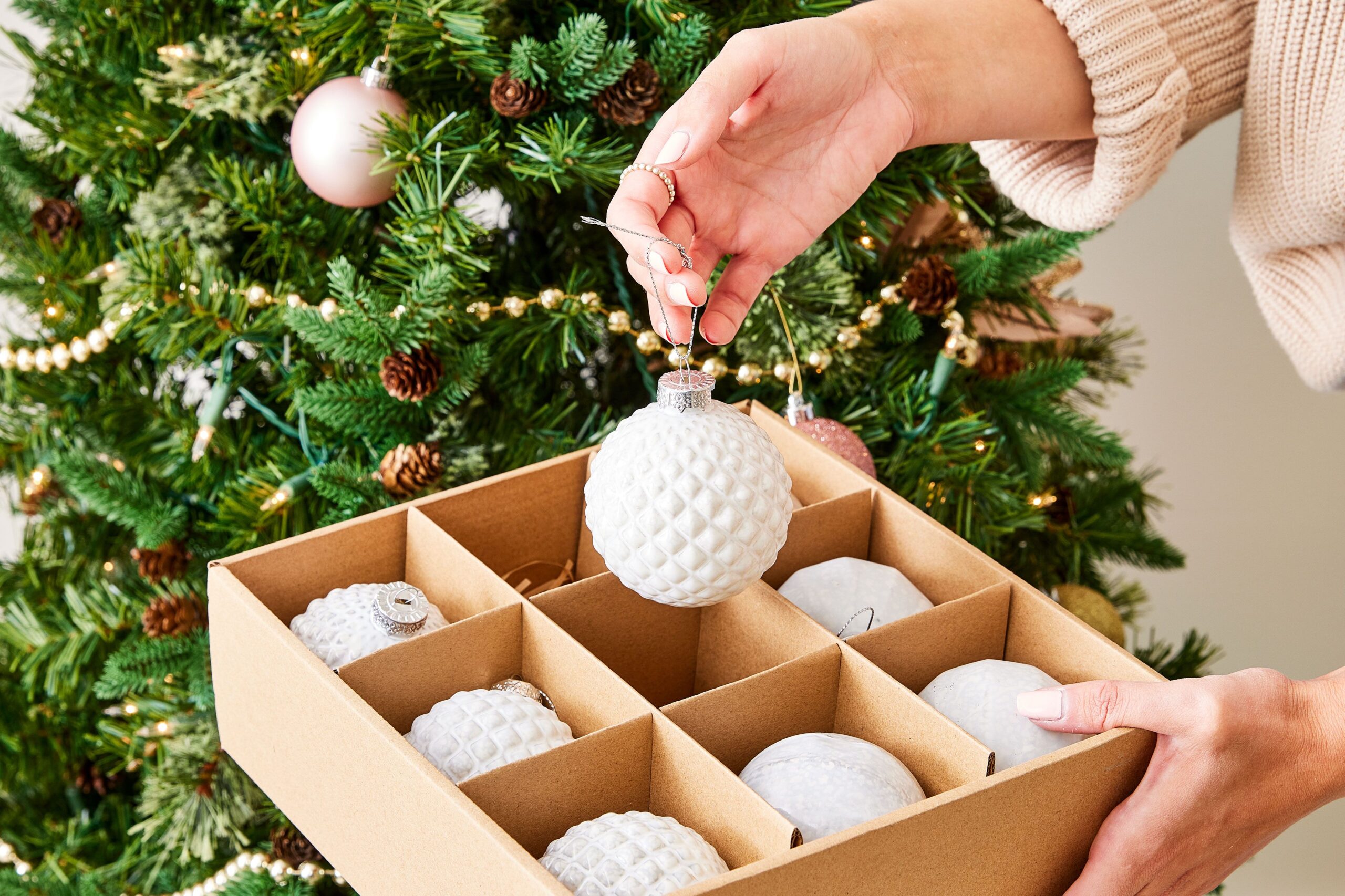
Rigid plastic containers with secure-locking lids are the appropriate baseline for commercial ornament storage. Divider inserts — either purpose-designed ornament dividers or customised foam inserts — prevent movement within the container and keep pieces separated throughout the storage period. Stackable designs maximise storage room efficiency, which matters considerably when a venue is managing inventory across multiple event spaces or seasonal rotations.
Label every container on the exterior with a brief contents description, the zone or event type the ornaments are assigned to, and any handling notes relevant to fragile pieces inside. This investment of two minutes per container saves significant time at the start of the next season.
Step Four: Control the Storage Environment
Even perfectly wrapped and containerised ornaments will deteriorate in the wrong environment. Temperature extremes cause expansion and contraction in glass and metal finishes. Humidity promotes tarnishing, mould growth on fabric or natural elements, and adhesive failure on decorative accents. Direct sunlight fades colour finishes over time.
Climate-controlled storage is the professional standard for high-value seasonal inventory. Where dedicated climate control is not available, prioritise interior storage locations away from exterior walls, rooflines, and any area subject to moisture infiltration. Silica gel desiccant packets placed inside containers provide an additional layer of humidity protection at minimal cost.
The Right Products Make Every Step Easier
Storage systems are only as effective as the products supporting them. For event professionals and venues that treat holiday décor as a long-term asset rather than a seasonal expense, working with suppliers who understand professional-grade quality — in both the decorations themselves and how they are designed to be stored and reused — makes a measurable difference across seasons.
From ornament collections built for repeated professional use to window candles and holiday décor designed with longevity in mind, 612 Vermont is a resource worth knowing for any venue or event team that holds its seasonal presentation to a high standard.
