



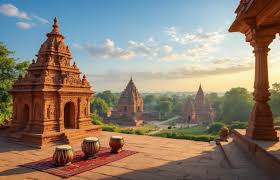
In the Bankura district of West Bengal lies the town of Bishnupur, which boasts one of the richest collections of terracotta temple architecture within the Indian subcontinent. The temples were built in the 17th and 18th centuries during the rule of the Malla kings.
Walking along the terracotta temple trail in Bishnupur offers one of the most authentic heritage experiences in eastern India. This is especially true for travellers who want to take the time to explore it properly.
Rasmancha: The starting point of the trail
The Rasmancha is the natural starting point for any visitor to the terracotta temple trail in Bishnupur, thanks to its dramatic architectural design. It also holds significant historical significance as a former gathering place for the idols used during the Ras festival in the reign of Malla king Bir Hambir.
The unique arched galleries, the pyramidal silhouette, and the building’s massive scale create a dramatic introduction for visitors that is sure to prepare them for the rest of their journey.
Jor Bangla Temple
The Jor Bangla Temple is where Bishnupur’s terracotta artistry reveals itself most completely and most breathtakingly for first-time visitors. Built in 1655 by Raghunath Singha, this double-hut style temple takes its form from traditional Bengali thatched-roof architecture and translates it magnificently into brick and terracotta.
Every surface of the exterior walls carries densely packed terracotta panels depicting events from the Ramayana, Mahabharata, Krishna Leela, and everyday Mughal-era life. These artworks display extraordinary narrative clarity and sculptural confidence.
Shyamrai Temple
Shyamrai Temple, built in 1643, introduces the pancharatna style to the trail and showcases a different dimension of Bishnupur’s architectural vocabulary. The five-towered structure rises with elegant proportions above its surrounding compound, and the terracotta panels covering its walls maintain the same extraordinary narrative density seen at Jor Bangla.
Scenes depicting the life of Krishna dominate the decorative programme here, reflecting the deep Vaishnavite devotional culture that shaped Malla patronage during temple construction.
Madan Mohan and Lalji temples
The Madan Mohan and Lalji temples sit close enough to each other to be visited comfortably as a paired stop within a single section of the trail. Madan Mohan, built in 1694, is an ek-ratna or single-towered temple whose relatively restrained exterior conceals beautifully detailed terracotta work across its lower panels and doorway surrounds.
The Lalji Temple nearby displays a similar architectural form but with terracotta panels that art historians consider among the finest surviving examples of the entire Bishnupur tradition.
Planning the heritage walk
Visitors to Bishnupur’s famous temple trail will find that what seems to be a manageable area to explore can take much longer than anticipated. Most visitors rush through this area by giving themselves a half-day for the temple tour. However, a full day would be much more appropriate.
Searching for hotels in Bishnupur in advance and booking at least one night in the town allows a relaxed morning start to the trail before the midday heat builds across the open temple compounds. October to March offers the most comfortable walking weather across the trail.
The bottom line
Bishnupur’s terracotta temple trail is one of the least visited, yet absolutely unparalleled among some of the popular, incredible heritage walk locations in all of India. The artistic ambition behind each temple built during the Malla dynasty continues to receive more recognition than has been given to date. If you appreciate Indian art and architecture, you owe it to yourself to spend at least one entire day when visiting Bishnupur.
