



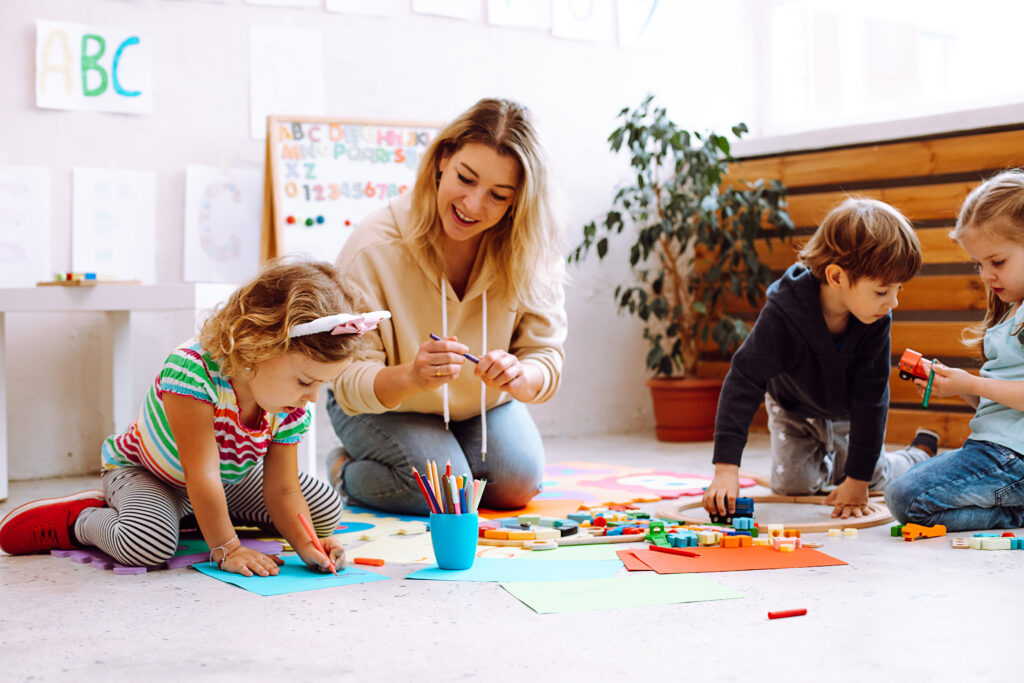
Kindergarten teachers can identify within the first week which children attended preschool and which didn’t – not primarily through academic skills, but through social and emotional capabilities. Children who’ve learned to manage feelings, cooperate with peers, follow routines, and navigate group settings adjust to school far more easily than those encountering these expectations for the first time. Academic knowledge matters, but a child who knows the alphabet yet melts down during transitions or can’t share materials struggles more than one with fewer academic skills but better emotional regulation and social awareness. Understanding what social and emotional development looks like during the preschool years helps parents recognize why these capabilities matter as much as – if not more than – letters and numbers when preparing children for formal schooling.
What Social and Emotional Skills Actually Mean
Social skills involve how children interact with others – taking turns, sharing, cooperating on activities, resolving conflicts, reading social cues, and forming friendships. Emotional skills relate to understanding and managing feelings – recognizing emotions in themselves and others, expressing feelings appropriately, handling frustration, recovering from disappointment, and self-regulating when upset or excited.
These capabilities sound abstract compared to concrete skills such as counting to ten or writing letters, but they’re actually quite observable. A child with developing social skills asks to join play rather than grabbing toys. They notice when a peer is sad and show concern. They navigate conflicts through words rather than physical aggression. A child with growing emotional skills can calm themselves after minor upsets without adult intervention. They can wait their turn without becoming distraught. They express needs and feelings with words rather than meltdowns.
These skills don’t develop automatically with age – they’re learned through experience and guidance. Children need opportunities to practice social interaction with same-age peers. They need adults who help them identify emotions and develop coping strategies. They need environments where they can safely make social mistakes and learn from them.
The Group Setting Advantage
Home environments, no matter how enriching, typically don’t provide the same social learning opportunities as group settings with multiple children. At home, a child might have siblings to interact with, but the age range and family dynamics create different social situations than peer groups. Parents naturally accommodate their children’s emotional needs in ways that group settings can’t replicate – and shouldn’t, because part of emotional development involves learning to function in contexts where individual needs aren’t immediately met.
Preschool provides daily practice with peer interactions – negotiating who gets which toy, working together on projects, navigating friendships, handling disagreements. These situations arise naturally and repeatedly, giving children many chances to develop and refine social skills. The presence of multiple children creates social complexity that teaches children to read group dynamics, not just one-on-one relationships.
Quality programs providing Preschool Auckland programs give families access to structured early education create environments where social and emotional learning happens intentionally, not just incidentally. Teachers facilitate interactions, model problem-solving, and guide children through social challenges in ways that build capabilities rather than just solving immediate problems.
Learning Emotional Regulation Through Structure
Preschool routines help children develop emotional regulation by creating predictable patterns they can rely on. Knowing what comes next reduces anxiety. Understanding expectations helps children manage their behavior. The structure provides a framework that supports emotional control in ways unstructured time doesn’t.
Transitions between activities challenge many young children emotionally. Moving from free play to circle time, from outdoor time to snack, requires stopping preferred activities and shifting focus. Preschool provides daily practice with these transitions. Over time, children develop the emotional flexibility to handle changes without distress. This capability transfers to school, where transitions happen constantly throughout the day.
Wait time during group activities teaches impulse control and delayed satisfaction. Sitting through circle time while others take turns requires managing the desire to speak or move. Waiting for a turn with popular materials develops patience. These small exercises in self-control build the emotional regulation needed for classroom environments where immediate satisfaction isn’t always possible.
Developing Empathy and Perspective-Taking
Young children naturally focus on their own experiences and feelings. Understanding that others have different thoughts, feelings, and perspectives develops gradually through social experience. Preschool accelerates this development by putting children in situations where others’ feelings become relevant and observable.
When a child sees a peer cry after getting hurt, empathy begins developing. When conflicts arise over toys or space, children learn that others have desires that conflict with their own. When teachers guide children to consider how their actions affect peers, perspective-taking skills emerge. These capabilities form the foundation for cooperative behavior and positive social relationships throughout life.
The diversity of peers in group settings exposes children to different communication styles, emotional expressions, and social approaches. This variety teaches flexibility and understanding that’s harder to develop in more homogeneous environments. Children learn that their way of doing things isn’t the only way, and that different approaches can be valid.
Building Independence and Confidence
Separation from parents for extended periods helps children develop confidence in their ability to function independently. Managing minor challenges without parental help – opening a snack container, resolving a disagreement with a friend, recovering from disappointment – builds self-reliance and emotional resilience.
This independence develops gradually. Children start with brief separations and extend to longer periods as comfort increases. They learn that parents always return, that they can trust other adults, and that they’re capable of managing in different environments. This confidence transfers to kindergarten, where children must separate from parents for full school days.
The small successes children experience in preschool – making a friend, completing a project, helping a peer, following instructions – build self-esteem based on actual capabilities rather than just parental praise. These authentic achievements create confidence that helps children approach new challenges positively.
Coping with Frustration and Disappointment
Preschool environments inevitably include situations where children don’t get what they want – someone else is using the desired toy, their artwork doesn’t look how they envisioned it, they don’t get chosen for a preferred activity. These disappointments, while difficult, provide opportunities to develop coping skills.
Teachers in quality programs help children process these feelings rather than just distracting them or immediately solving problems. Children learn that disappointment is tolerable, that upset feelings pass, and that they can handle not getting their way. These lessons prove critical in school settings where children face frequent minor disappointments throughout each day.
The problem-solving skills children develop when facing challenges transfer broadly. A child who learns to persist when a puzzle is difficult approaches academic challenges more positively. One who learns to seek help appropriately when stuck navigates classroom learning more effectively.
Understanding and Following Group Expectations
Kindergarten requires following instructions, participating in group activities, respecting others’ space and belongings, and managing behavior appropriately. Children entering school without experience in group settings often struggle with these expectations. They’re not being defiant – they simply haven’t had opportunities to practice these skills.
Preschool teaches children to function as part of a group rather than as individuals with adult support always immediately available. They learn to raise hands instead of calling out, to wait for instructions rather than acting immediately, to stay with the group during transitions. These capabilities seem basic to adults but represent significant learning for young children.
The behavioral expectations in preschool gradually increase in complexity as children develop. Early expectations might be very simple – sit during story time, use gentle hands. Later expectations build on these foundations – listen while others speak, help clean up materials, include peers in play. This progressive development prepares children for kindergarten behavior expectations without overwhelming them.
The Long-Term Impact
Research consistently shows that children who develop strong social and emotional skills during the preschool years show better academic outcomes, fewer behavior problems, and stronger relationships throughout school years. These early capabilities provide the foundation for later learning and social success in ways that early academic skills alone don’t.
The social and emotional learning that happens before kindergarten isn’t separate from academic preparation – it’s fundamental to it. Children who can manage their emotions, cooperate with others, and navigate group settings are positioned to benefit from academic instruction in ways that children without these skills struggle to match. Building these capabilities during the preschool years represents an investment that pays dividends throughout children’s educational journeys.
