



Introduction
Modern industries rely heavily on precision. From manufacturing and construction to aerospace and automotive engineering, even the smallest measurement error can lead to costly defects or safety risks. One of the most advanced solutions addressing this challenge is laser scanning technology. How a 3D Laser Scanner Improves Industrial Measurement Accuracy has become a key topic in industrial automation because of its ability to deliver highly detailed and reliable measurement data in a fraction of the time compared to traditional methods.
What is a 3D Laser Scanner?
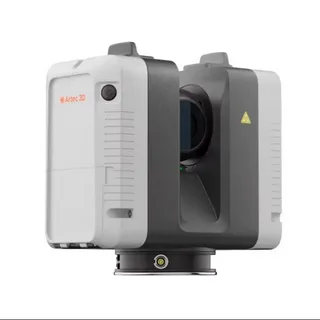
A 3D laser scanner is a device that captures the shape, size, and dimensions of physical objects using laser beams. It creates a “point cloud,” which is a digital representation of the scanned object in three-dimensional space. This data can then be used for inspection, modeling, reverse engineering, and quality control.
Unlike manual measurement tools such as calipers or tape measures, laser scanners provide millions of measurement points in seconds, ensuring extremely high precision and consistency.
How a 3D Laser Scanner Improves Industrial Measurement Accuracy in Manufacturing
One of the most significant benefits of modern scanning systems is their impact on manufacturing processes. How a 3D Laser Scanner Improves Industrial Measurement Accuracy can be clearly seen in quality control departments where components must meet strict tolerances.
Laser scanners eliminate human error by automating the measurement process. They also detect even microscopic deviations in parts, ensuring that every component meets design specifications before assembly. This reduces waste, improves product quality, and minimizes production delays.
Key Benefits of 3D Laser Scanning Technology
1. High Precision and Detail
Laser scanners capture extremely fine details, allowing engineers to detect defects that would be impossible to see with traditional tools.
2. Speed and Efficiency
Large industrial components that once took hours to measure manually can now be scanned in minutes.
3. Non-Contact Measurement
Since the process is non-invasive, it is ideal for delicate, hot, or hazardous objects.
4. Improved Data Analysis
The digital models generated help engineers analyze structures more effectively and make better design decisions.
How a 3D Laser Scanner Improves Industrial Measurement Accuracy in Quality Control
Quality control is one of the most critical areas where laser scanning excels. How a 3D Laser Scanner Improves Industrial Measurement Accuracy is especially important in industries like aerospace and automotive manufacturing, where precision is non-negotiable.
By comparing scanned data with original CAD models, engineers can quickly identify deviations. This process, known as inspection or deviation analysis, ensures that defective parts are detected early in the production cycle, reducing costly recalls and rework.
Applications Across Industries
Aerospace Industry
Used for inspecting turbine blades, fuselage structures, and engine components with extreme precision.
Automotive Industry
Helps in verifying car body alignment, engine parts, and chassis structures.
Construction and Architecture
Used for site surveys, building documentation, and structural analysis.
Energy Sector
Supports inspection of pipelines, turbines, and power plant equipment.
Why Industries Are Adopting 3D Laser Scanning
The growing demand for automation and digital transformation has made laser scanning a standard tool in modern industries. Companies are increasingly investing in this technology to improve accuracy, reduce costs, and enhance productivity.
Another reason behind its popularity is its integration with CAD and BIM systems, allowing seamless workflow between physical measurements and digital design environments.
Conclusion
In today’s highly competitive industrial environment, precision is everything. How a 3D Laser Scanner Improves Industrial Measurement Accuracy is no longer just a technical concept but a practical necessity for businesses aiming to maintain quality and efficiency. By delivering fast, accurate, and reliable measurement data, 3D laser scanners are revolutionizing how industries design, inspect, and manufacture products.
As technology continues to evolve, the role of laser scanning will only become more essential in ensuring accuracy and innovation across all engineering fields.
