



Discovering a new skincare ingredient is one thing. Knowing how to use it correctly — in the right formulation, at the right point in a routine, layered with the right supporting ingredients — is what determines whether it actually delivers results. Dragon’s blood has earned genuine attention in the professional skincare community for its antioxidant, anti-inflammatory, and skin-renewing properties, but for many women encountering it for the first time, the practical question remains unanswered. Understanding how to use dragon’s blood for skin effectively requires knowing what the ingredient does at a biological level, what formats it is best delivered in, and how it fits within the context of a broader skincare routine.
What Dragon’s Blood Is and Why Application Method Matters
Dragon’s blood is a deep red resin extracted from the Croton lechleri tree, native to the rainforests of South America. Its key bioactive compounds — taspine, proanthocyanidins, and a range of lignans and phenolic compounds — each interact with skin differently depending on how they are formulated and applied. This is not an ingredient where the format is incidental. The delivery mechanism directly influences which properties are most active on the skin and how efficiently the bioactives are absorbed.
Understanding this from the outset helps consumers move past the novelty of the ingredient and toward the more practical question of which dragon’s blood product, used in which way, serves their specific skin concerns.
Serums: The Highest Concentration Delivery Format
For women whose primary interest in dragon’s blood is its antioxidant protection and anti-aging activity, a serum formulation is typically the most effective entry point. Serums are designed for penetration — lower molecular weight carriers allow bioactive compounds to move efficiently through the upper layers of skin and reach the dermal environment where collagen-producing fibroblast cells are active.
A dragon’s blood serum applied to clean, dry skin before moisturiser allows the proanthocyanidins and taspine to work at their most concentrated and unobstructed. This is the application format best suited to targeting fine lines, supporting skin firmness, and delivering meaningful antioxidant defence against the daily oxidative load of UV exposure and environmental pollution.
Application technique matters here. A small amount — typically three to five drops — warmed between fingertips before pressing gently into the skin ensures even distribution without dragging across the surface. Allowing the serum to absorb for sixty seconds before layering a moisturiser on top prevents dilution of the active compounds before they have made contact with the skin.
Creams: Barrier Support and Sustained Hydration
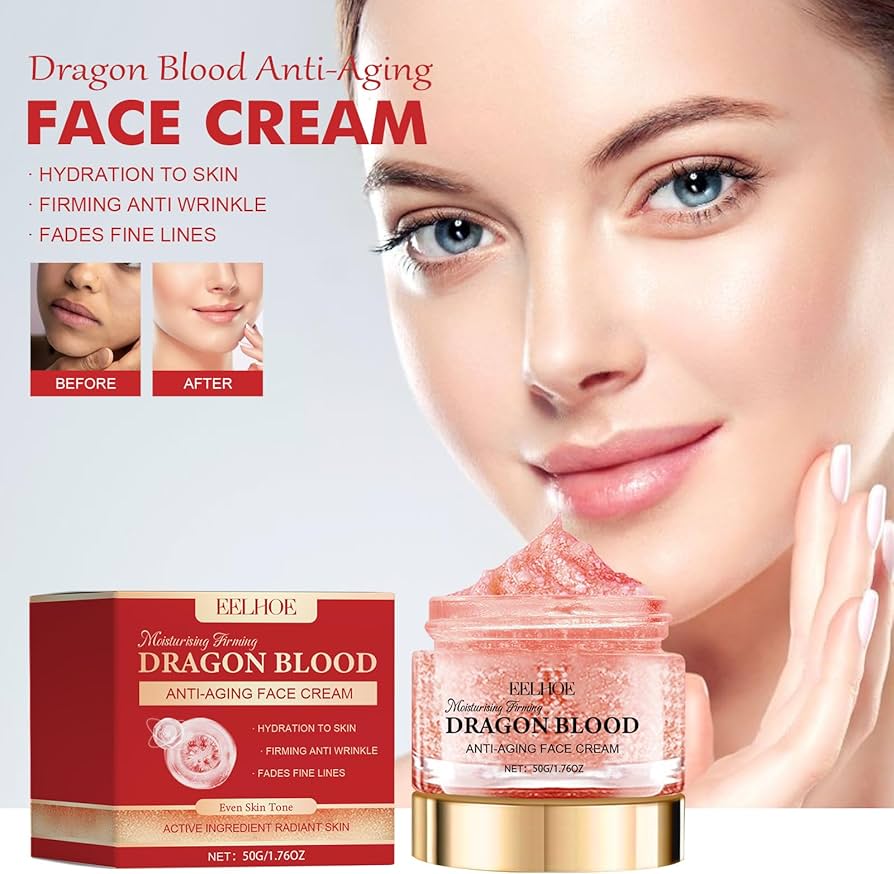
Dragon’s blood formulated into a cream or moisturiser serves a different but complementary function. The occlusive and emollient components of a cream formulation slow transepidermal water loss, supporting the skin barrier that dragon’s blood bioactives help to repair. This combination — barrier-active ingredients alongside barrier-protective delivery — makes a dragon’s blood cream particularly well suited to skin that presents with both sensitivity and early aging concerns simultaneously.
For women in their late thirties and forties dealing with a compromised or reactive skin barrier alongside visible signs of aging, this format offers a practical consolidation of concerns into a single product step. Applied as the final step in a morning or evening routine, a dragon’s blood cream seals the benefits of any preceding active ingredients while contributing its own anti-inflammatory and skin-renewing activity throughout the wear period.
Layering Dragon’s Blood With Other Actives
One of the practical advantages of dragon’s blood as a skincare ingredient is its compatibility with a broad range of other actives. Its anti-inflammatory properties make it a useful complement to ingredients that can provoke initial sensitivity — retinol, vitamin C, and AHA exfoliants among them.
Applied after a retinol treatment in an evening routine, a dragon’s blood cream or serum can help moderate the transient irritation that retinol use sometimes produces during the adjustment period, without interfering with the retinol’s mechanism of action. Similarly, pairing dragon’s blood with a vitamin C serum in a morning routine creates a complementary antioxidant layer that extends the protective coverage of both ingredients.
What dragon’s blood does not require is a complex surrounding routine to be effective. For women who prefer a streamlined approach, a single well-formulated dragon’s blood product used consistently will deliver more meaningful results than multiple products used intermittently.
Consistency Is the Active Ingredient
No topical skincare ingredient — regardless of its bioactive profile — delivers transformation through occasional use. The clinical properties associated with dragon’s blood, particularly its influence on fibroblast activity and collagen stimulation, operate on a timeline measured in weeks and months of consistent application rather than immediate visible change.
Building dragon’s blood into a daily routine — whether as a serum, cream, or targeted treatment — and allowing sufficient time to observe its cumulative effect is the practical prerequisite for the results the ingredient is genuinely capable of delivering. For women approaching skincare as a long-term investment in skin health rather than a pursuit of immediate results, that timeline is entirely consistent with how effective skincare works.
Essance Skincare formulates its dragon’s blood products with this principle at the centre — prioritising bioactive integrity and formulation quality over trend-driven positioning, for consumers who understand the difference.
