



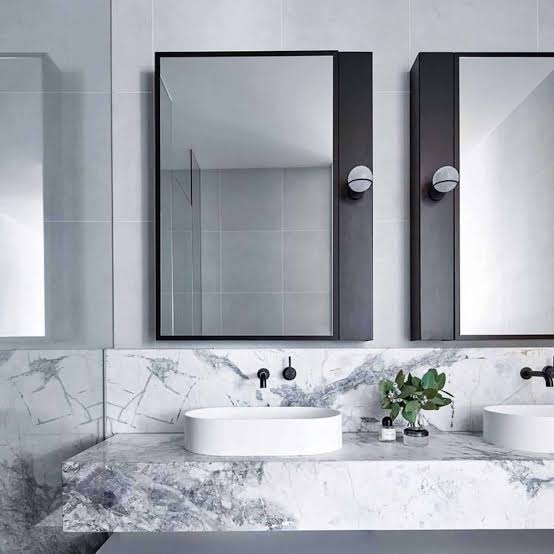
Every bathroom renovation guide seems to push toward LED everything, but medicine cabinets without lights still make up a large share of what actually sells. That’s not a step backward. For a lot of bathrooms, skipping the built-in lighting is the more practical choice, not the compromise one.
Why Unlit Still Makes Sense
Built-in lighting sounds like an obvious upgrade until you account for what it actually requires: wiring, a driver, GFCI protection near a sink, and a price premium that can run several hundred dollars above a comparable unlit model.
A few situations where skipping the lighting is the more sensible call:
- The bathroom already has strong, well-placed vanity lighting that doesn’t need reinforcement at the mirror
- The space is a guest bath or powder room with light daily use, where the added cost is hard to justify
- The wall doesn’t have easy electrical access, making a hardwired installation expensive or impractical
- The homeowner wants a straightforward retrofit without hiring an electrician
None of these situations are about settling for less. They’re about matching the fixture to how the room actually gets used, rather than defaulting to whatever feature list looks most impressive on paper.
What to Look for Instead of Lighting Specs
Without electronics to compare, the decision shifts entirely to construction quality and mirror clarity. These are the details that actually separate a good unlit cabinet from a disappointing one:
- Mirror quality and edge finishing. Look for a polished or beveled edge over a raw-cut one, and check for any visible warping near the frame, which becomes more noticeable without a light source to distract from it.
- Hinge type. Soft-close hinges outlast standard spring hinges by years, particularly with the daily open-close cycle a medicine cabinet gets.
- Shelf configuration. Adjustable tempered glass shelves handle a wider range of bottle heights than fixed plastic ones, which matters more in a cabinet relying purely on interior space.
- Door seal and catch. A magnetic door catch keeps the cabinet flush against the wall in a humid environment where material can shift slightly over time.
- Frame material. Stainless steel or powder-coated aluminum resists moisture better than untreated composite, extending the cabinet’s usable life regardless of lighting.
Depth matters just as much here as it does on a lit version. Anything under 4 inches interior depth will feel tight for standard-height bottles, so it’s worth checking that measurement even when lighting isn’t part of the comparison.
Installation Advantages Worth Knowing
One of the clearest benefits of skipping the lighting is a simpler installation process, and that simplicity shows up in a few concrete ways:
- No electrical work required. Without a light source, there’s no need for a junction box, GFCI circuit, or driver, which removes an entire category of installation cost and risk.
- Lighter overall weight. Without built-in electronics, the cabinet weighs less, which means standard wall anchors are usually sufficient even on larger sizes.
- Faster DIY timeline. A straightforward mount-and-level installation can often be completed in under an hour, compared to a half-day or more for a hardwired lit version.
- No dimmer or driver compatibility issues. There’s nothing to troubleshoot if the mirror doesn’t light up correctly, since there’s no electrical component to fail in the first place.
- Lower long-term maintenance. LED drivers and touch sensors can fail years down the line; a purely reflective cabinet has no electronics to eventually replace.
For anyone doing a DIY bathroom refresh without an electrician on the project, these differences often outweigh the appeal of built-in lighting entirely.
When to Reconsider
None of this means lighting is never worth it. A primary bathroom with poor overhead lighting, heavy daily use, or a household that relies on accurate color rendering for makeup or grooming may still get real value from a lit cabinet, even with the added cost and installation complexity. The right call depends on the room, not a general rule either way.
Retailers such as Allsumhome carry both lit and unlit configurations side by side, which makes it easier to compare mirror quality and hardware specs directly instead of assuming the lit version is automatically the better choice.
The Bottom Line
Medicine cabinets without lights aren’t a downgrade, they’re a different set of tradeoffs. Skipping the electronics means a simpler installation, a lower price point, and one less thing that can eventually fail, in exchange for relying on whatever lighting already exists in the room. For a bathroom with decent vanity lighting already in place, that tradeoff often makes more sense than paying for a feature the room doesn’t need.
